How to write a hook for an essay: 11 types with examples


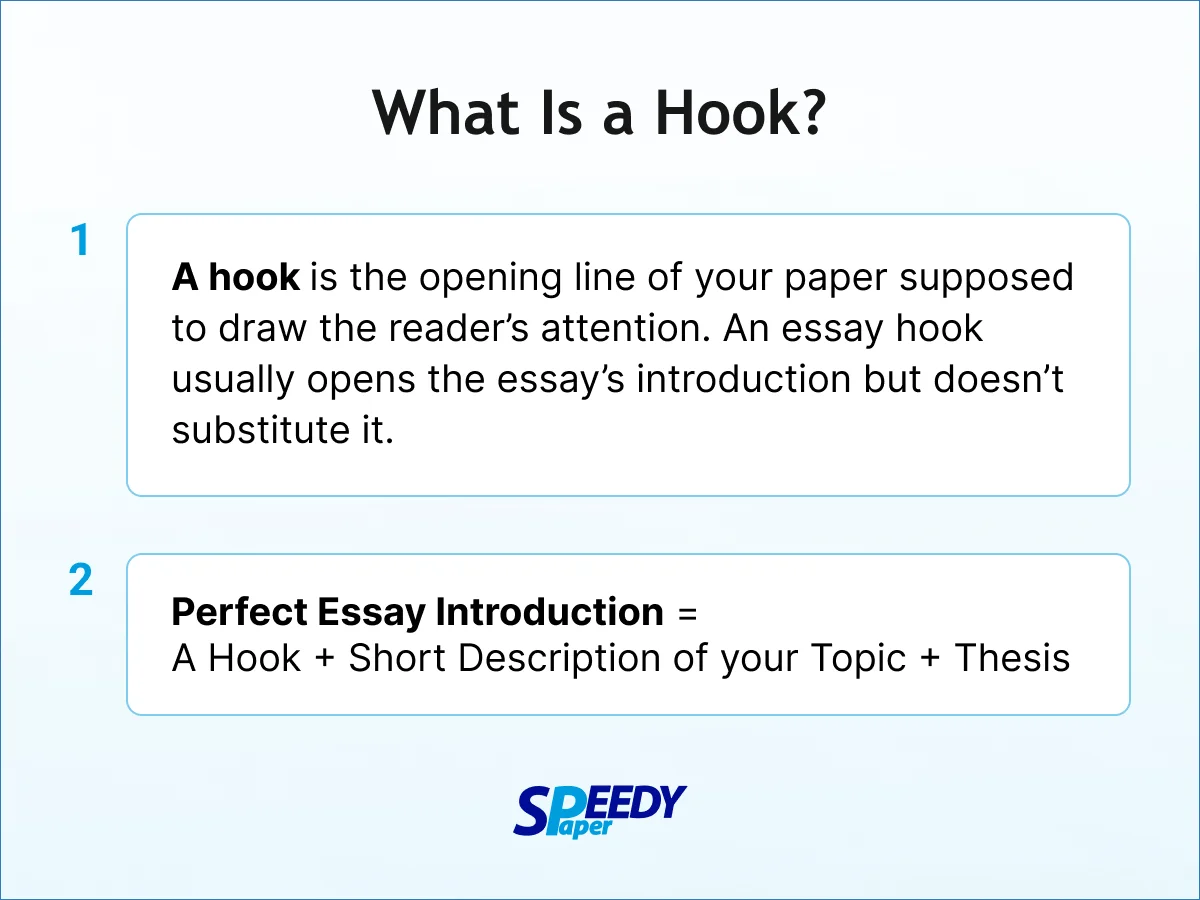
The first line of an essay is like an opening scene in a movie. If the opening is drawn-out and dull, you’ll pick something else to stream, and so will your readers if you fail to grab their attention within the first few seconds. An essay hook is an opening sentence or short passage designed to capture the reader’s interest and lead into your topic. To write a good hook for an essay, consider your topic, audience, and purpose, then choose an engaging question, surprising fact, bold statement, or another opening that fits your argument. Below, you’ll find a step-by-step guide, 11 types of essay hooks with examples, and tips for choosing the right one.
How to write a hook for an essay step by step
A good essay hook should grab attention while introducing the topic naturally. Follow these four steps to create an opening that fits your assignment.
Step 1. Consider your essay type and audience
Before writing your hook, answer a few questions:
- Is your essay argumentative, narrative, informative, or personal?
- Which tone and writing style will you use?
- Who do you expect (or want) to read your work?
- Will you go with a traditional structure or a creative one?
Your answers will help you decide whether to start with a question, fact, personal experience, or another type of hook.
Step 2. Choose a hook that fits your topic
Think about what makes your topic interesting or surprising. You might use a thought-provoking question, an unexpected statistic, a bold statement, or a short story. Choose an approach that supports your essay's purpose rather than simply attracting attention.
Step 3. Write a clear and engaging opening
Draft one or two sentences that introduce an interesting idea without giving away your entire argument. Avoid generic statements, unsupported claims, and overly complicated language. If you use a fact, statistic, or quotation, make sure it is accurate and properly attributed.
Step 4. Connect the hook to your thesis
Remember that the hook is only the first part of an essay. You can't lure the reader in without building on your momentum. The opening paragraph should also introduce your topic and provide a strong thesis statement. Add a natural transition between your hook and the main argument so the introduction feels connected. For more guidance on building an effective introduction, see our guide on how to start an essay.
Writing tip from SpeedyPaper
11 types of essay hooks
Now that you know how to write an essay hook step by step, let's explore 11 types of essay hooks with examples. You'll also learn which types work best for different assignments.

1. Question hook
Human brains are wired to answer questions, so an exciting question hook is universal and works for most assignment types. Besides, it can be easy to develop. But remember to avoid yes or no questions and make your queries pointed and thought-provoking. You can also include a series of pointed questions, but don’t turn your introduction into an interrogation. Too many questions, just like generic queries, will not engage the reader, which is what a good hook is all about.
What made Germans blindly follow Hitler’s world domination plans?
Does knowing the estimated date of death make people act differently?
2. Strong statement hook
Starting your paper with a bold declaration is easy. All you need to do is answer a provocative question with a controversial response. But remember that your declaration hook should be in line with the rest of the introduction and paper as a whole, meaning there should be enough evidence to support your claim. Without backing, your hook is nothing but clickbait, and no one likes that.
Sugar is as strong a drug as narcotics and should be similarly regulated.
3. Fact or definition hook
Starting a college essay with a dictionary definition is a common but often ineffective approach. However, a carefully chosen definition can still work if it introduces an unfamiliar or complex concept relevant to your argument. The problem is that most definitions are obvious and rather dull. So in most cases, an interesting fact or an unexpected interpretation of the definition would be a better choice for an essay hook.
Urban Dictionary includes dozens of colloquial words and phrases for drugs and addiction, from Mary Jane to Jim Jones and beyond.
4. Statistic hook
Just like questions, our brains love numbers. That’s why so many posts online start with “Top-10”. You can use this psychology quirk to your advantage if you find a figure that fits your topic and is unexpected enough to surprise your readers into wanting to learn more. Remember to cite the source of information used in your hook for an essay, as it’s unlikely to be common knowledge.
In 2021, China had approximately 30 million more men than women, reflecting a long-standing gender imbalance shaped partly by sex-selective birth practices.
5. Metaphor hook
Creative writing assignments are well-suited for using a metaphor hook, as they often allow more expressive language and imagery. A metaphor compares two different things without using “like” or “as.” You can weave an extended metaphor throughout the paper, finding similarities between different subjects and topics. But don’t mix in unrelated metaphors, as this may confuse the reader.
School is a prison where students serve years of mandatory sentences. Principals are the wardens, and teachers are the guards.
6. Personal story hook
If you’re working on a personal essay or your college admission paperwork, opening with a short scene from your experience is a logical choice of an essay hook. As with all other hook types, your story should be relevant to the narrative and short enough to fit within the first couple of sentences. Ask your professor if the first-person narration is appropriate if you’re not sure starting with “I” is a good idea.
I was at the beach with my grandma when I nearly drowned. It was her dog who saved me.
Writing tip from SpeedyPaper
7. Description hook
So many books start with a brief yet vivid description of a scene because most of us are visual thinkers. We need details to see the setting before our mind’s eye. You can lead your paper with a backdrop and add sounds, smells, and other sensory information to make it more memorable.
Sitting in front of a tiny fire, listening to the crackling of wood, and huddling under scratchy wool blankets, the travelers didn’t know what was waiting for them in the morning.
8. Quotation hook
Opening an essay with a relevant literary quotation or a quote from a notable figure can be effective when it directly supports your topic and fits the assignment's requirements. If other hook types don't fit your essay, consider using a relevant quotation that supports your topic. You can now use Google to find thousands of quotes on any topic, so be picky and choose the line that works best with the rest of your paper. You can lead with the quote or build it into your analysis, question, or statement.
John F. Kennedy said, “ask not what your country can do for you,” but what does the US do for its citizens?
9. Common misconception
Disproving myths and misconceptions is a great way to open an informative essay, as it presents surprising data in a non-confrontational way. Make sure your essay hook relies on objective and trustworthy data; otherwise, the rest of your paper will look weak.
Many people assume decaffeinated coffee contains no caffeine, but even decaf can contain small amounts of it.
10. Anecdotal hook
“Anecdotal” doesn’t always mean funny or humorous, though your opening lines can certainly be so, especially if you’re working on a narrative or personal piece. An anecdote is a short story that relates to the essay topic and draws the reader’s attention. Unlike a personal story hook, which focuses on your own experience, an anecdotal hook can describe someone else's experience or a relevant event. If you use this type of hook, make sure the storytelling style fits your assignment's requirements.
When a young Bill Gates saw an article about the Altair 8800 computer, he and Paul Allen recognized an opportunity. Soon, they were developing software for a machine they had never even seen in person.
11. Thesis statement hook
Traditionally, introductions use the hook and background information to lead the reader to the thesis statement at the end of the first paragraph. However, you can open with the thesis if you think it’s interesting and exciting. In this case, you’ll provide background information after the thesis, so you’ll need to think of a good transition into the first body paragraph.
Humanity is on a path to self-destruction, so space colonization may be the only way to preserve humankind and start from a blank slate without repeating the same mistakes we made on Earth.
How to choose the right hook for your essay
With so many options available, you’re probably wondering how to choose a good hook for your assignment. Let’s compare examples of essay hooks and see which types work best for different assignments.
| Type of hook | Example hook | Best suited for |
|---|---|---|
| Question | What use are college classes if they don’t teach anything about real life? | Argumentative, persuasive, personal, and informative essays |
| Strong statement | College education is useless because it doesn’t teach anything about real life. | Argumentative and persuasive essays |
| Fact or definition | A college degree is an academic qualification awarded after completing a program of higher education, but its value extends beyond the diploma itself. | Informative and explanatory essays |
| Statistic | According to the National Center for Education Statistics, 64% of first-time, full-time students who began pursuing a bachelor's degree at a four-year institution in fall 2014 graduated from the same institution within six years. | Research-based, argumentative, and informative essays |
| Metaphor | Getting a college degree is a gamble: you might gain valuable opportunities or end up with debt. | Personal, narrative, and creative writing |
| Personal story | My mom didn’t speak to me for a month after I said I wouldn’t be applying to college. | Personal, narrative, and reflective essays |
| Description | The sea of people flooded the courtyard on graduation day, and their voices blended into the sound of crashing waves. | Personal, narrative, and descriptive essays |
| Quotation | Nelson Mandela believed that “education is the most powerful weapon you can use to change the world.” | Argumentative, persuasive, and reflective essays |
| Common misconception | Bill Gates and Mark Zuckerberg are often cited as examples of successful college dropouts, but their stories don’t mean that leaving college guarantees business success. | Argumentative and informative essays |
| Anecdote | When Sarah announced she was dropping out of college, her family thought she was making a terrible mistake. Five years later, she was running her own successful business. | Narrative, informative, and persuasive essays |
| Thesis statement | A college degree can open doors to better career opportunities, but its value depends on the student’s goals, chosen field, and financial circumstances. | Argumentative and persuasive essays |
The best hook depends on your topic, audience, and assignment requirements. These recommendations are guidelines, not strict rules. Choose an opening that captures attention while leading naturally into your thesis statement.
Where to find ideas for writing an essay hook
Once you’ve chosen a suitable hook style, the next step is to find a compelling idea, example, or piece of information. If you’re stumped, consider one or more of the following sources to find a good hook for an essay:
- TED Talks and scientific clips. Many start with an intriguing hook you can use as inspiration for your own opening.
- Statista, government databases, and other statistics sources. Numbers draw attention and make your writing look well-researched.
- Scientific articles. Pay attention to abstracts, conclusions, and visual aids, as they hold the critical information you can use.
- Best-selling fiction and non-fiction books. Skim the first paragraphs of your favorite reads to remember what drew you in.
Professional writers spend decades honing their skills, so don’t be disappointed if you cannot come up with a good essay hook on your first try. The more you work on it, the better your essay openings will become. And you can always turn to our write my essay assistance if you need a hand with the introduction.
Writing tip from SpeedyPaper
Real essay hook examples from student papers
Want to see how essay hooks work in practice? Here are two examples from student papers in our essay sample library. Each uses a different technique to capture the reader's attention.
Question hook example
In The Most Difficult Academic Problem, the writer opens with a question about missing a freeway exit while distracted. This familiar situation draws readers in and introduces an analogy for overcoming an academic challenge.
Personal story hook example
In Story About My Life, the writer begins by recalling their first and last appearance in a school play. The unexpected detail creates curiosity and encourages readers to discover what happened.
Both examples show how an effective hook can introduce a topic while giving readers a reason to keep reading.
Final word of advice
Now you know how to write a good hook for an essay, whether it’s your admission application or routine assignment. Once your introduction is ready, you can also learn how to title an essay to give your paper a clear and engaging title. But what if you’re stuck at the prewriting stage, still brainstorming topics? SpeedyPaper can help with that, too. Our extensive library hosts thousands of samples you can use to develop an exciting topic and find references and insights on how to write a creative essay or a research paper. If you need additional help, our experts can also do your research paper.
Sources
- 1
Writing the Introduction. (2025). Purdue University Global Academic Success Center.
https://purdueglobalwriting.center/2025/09/26/writing-the-introduction - 2
Introductions. (n.d.). Harvard College Writing Center.
https://writingcenter.fas.harvard.edu/introductions - 3
Writing Your First Sentence. (n.d.). George Mason University Writing Center.
https://writingcenter.gmu.edu/writing-resources/general-writing-practices/writing-your-first-sentence
Related articles