How to write a cause and effect essay


A cause and effect essay explains why something happens and what results from it. Its purpose is to examine the causes of an event, situation, or trend, explain its effects, and show how these factors are connected through evidence and reasoning. To write one, narrow your topic, investigate possible causes and effects, support their connection with evidence, and organize your findings around a focused thesis. The six steps below show how to turn that process into a finished essay.
How to write a cause and effect essay step by step
Your assignment requirements should guide your writing process. But if you’re still wary and unsure of how to write a cause and effect essay, you can follow our step-by-step plan to get from a blank page to a finished essay quickly and without a fuss.
1. Brainstorm the topic
If you don’t know where to begin, start with our collection of cause and effect essay topics and go from there. You can also look into the assigned reading list and related publications. And once you have a couple of ideas in mind, present them to your professor and ask for their recommendation on the best choice. This way, you’ll be sure your topic is suitable for the assignment and catch your instructor’s attention.
For example, narrow the topic to sleep deprivation among college students. List late-night studying, social activities, and poor time management as possible contributors, then separate them from potential effects such as difficulty concentrating, remembering information, and completing coursework. These are starting hypotheses, not findings; research must establish which relationships your essay can support.
2. Research the causal relationships and create an outline
You can start with the body paragraphs once your thesis and outline are ready, then write the introduction after developing your argument. Give each paragraph a clear focus on a particular cause, effect, or link between them. Begin with a topic sentence, introduce relevant evidence, and explain how that evidence supports the relationship you are discussing. Use transitions to show how the causes and effects connect rather than presenting them as unrelated facts. After completing the body, write a conclusion that brings your findings together and return to the introduction to make sure it accurately reflects your argument.
For the sleep example, test the proposed chain: late-night activities may leave less time for sleep; insufficient sleep can impair attention and memory; those difficulties may interfere with coursework. Look for research that supports each link, not just a survey showing that tired students also have lower grades. Ask whether the cause comes before the effect, how it could produce that effect, and whether stress, work schedules, or other factors offer an alternative explanation. A correlation alone does not establish causation. If your evidence only shows an association, describe it as one and narrow your claim. Then choose a layout that follows the relationships your evidence actually supports.
3. Compose a thesis statement
Think of it as a trial run for your essay outline. If your main causes and effects are in order, it should be easy to put them together in a sentence. If the connection is unclear, revisit your evidence and essay plan. Your thesis should identify the main causal relationship and scope of your paper, rather than list every possible cause and effect. Although a working thesis can guide your draft, remember to revisit it after the paper is finished and revise it to fit your narrative better.
A working thesis for the same example could be: Late-night studying and social commitments can reduce college students’ sleep, making coursework harder to complete through difficulties with attention and memory. This sentence identifies possible causes, an intermediate effect, and the outcome the essay will examine. Keep that wording only if your research supports the whole chain; otherwise, limit the thesis to the relationship you can substantiate.
4. Write the body paragraphs
Starting with an introduction can feel difficult before your argument is clear. Try completing the body paragraphs first. It should be easier, as you already have all the necessary reference data and a clear plan. So all you need to do is put them together, mixing in your analysis. With body paragraphs in place, complete the conclusion and finally circle back to develop a compelling and exciting introduction. It should be much easier than starting with a blank page.
Here is a short model body paragraph for the same example: Sleep loss can make coursework harder by weakening attention and memory. The National Heart, Lung, and Blood Institute explains that insufficient sleep can interfere with focusing, remembering information, and finishing tasks. These difficulties help explain why a student who sleeps too little may struggle to follow a lecture or complete an assignment. This evidence supports the link between insufficient sleep and learning difficulties; it does not, by itself, show that social commitments caused a particular student’s sleep loss. In your essay, cite the source in the required style and add evidence for the other links in your thesis.
5. Revise and edit the first draft
Do not submit your first cause and effect essay draft. It’s the fastest way of getting a disappointing grade after putting in all that effort. Instead, take a short break and return to the paper to go over it with a critical eye. Does the layout make sense? Do the causes seem valid? Is there enough analysis to tie the facts together? If something seems weird, awkward, or redundant, delete or replace it. If possible, exchange papers with a classmate or a friend to provide mutual feedback. When academic deadlines pile up, you can also buy coursework to keep your assignments organized and completed on time.
6. Format the final draft
After you’re 100% finished editing and proofreading the paper, make it look pretty. Check the assignment requirements to find the necessary formatting and citation style. Implement typeface, font size, margin, and heading requirements. And pay special attention to in-text citations and the reference list. Even if you use automatic citation generators, double-check every entry to ensure it’s properly formatted and fits smoothly into your paper. While it may seem like a waste of time, proper formatting is key to making a good first impression, so do not skip this step.
Writing tip from SpeedyPaper
Cause and effect essay structure and outline
Building a strong outline is key to writing a good cause and effect essay. And you need to do it before you start writing to save time and avoid unnecessary rewrites when you realize your narrative doesn’t make sense.
Although the typical cause and effect essay outline includes the same three parts as any other essay (introduction, body, conclusion), the specifics may differ depending on
- Word count requirements
- The number of causes
- The number of effects
- The relationship between causes and effects
The basic outline will look like this:
- Introduction
- Hook
- Background info
- Thesis statement
- Body
- Paragraph 1
- Topic sentence
- Reference data
- Analysis
- Transition
- Paragraph 2
- Topic sentence
- Reference data
- Analysis
- Transition
- Paragraph 3
- Topic sentence
- Reference data
- Analysis
- Transition
- Paragraph 1
- Conclusion
- Summary of the main points
- Reiteration of the thesis statement
- Final thoughts
Understanding how each part of a cause and effect essay works will help you structure your argument clearly and logically.
Cause and effect essay introduction
The opening paragraphs in the cause and effect essay structure should include three major points. First, grab the reader’s attention with a hook, such as a quote, statistic, or question. Next, explain your reasoning for choosing the topic, or share the background information the audience needs to understand your narrative. Finally, include a thesis statement that identifies the main causal relationship your essay will examine. Rather than listing every possible cause and effect, focus on the central connection and the scope of your argument. Your thesis should give readers a clear idea of what the body paragraphs will explain and support with evidence.
Writing tip from SpeedyPaper
Cause and effect essay body paragraphs
Most students struggle with the cause and effect essay body paragraph order because they can’t find a clear and logical way to combine multiple reasons and effects. The best order depends on what you discover during research. Below, you’ll find a few options, depending on the number of causes and effects you come up with.
| Paragraph | One cause with multiple effects | One effect with multiple causes | Alternating causes and effects in separate paragraphs | Causes followed by effects (block structure) | Paired cause-and-effect relationships within paragraphs |
|---|---|---|---|---|---|
| 1 | Cause | Cause 1 | Cause 1 | Cause 1 | Cause 1 + effect 1 |
| 2 | Effect 1 | Cause 2 | Effect 1 | Cause 2 | Cause 2 + effect 2 |
| 3 | Effect 2 | Cause 3 | Cause 2 | Effect 1 | Cause 3 + effect 3 |
| 4 | Effect 3 | Compound causes | Effect 2 | Effect 2 | Cause 4 + effect 4 |
| 5 | Compound effect | Effect | Relationship between causes and effects | Relationship between causes and effects | Relationship between causes and effects |
Writing tip from SpeedyPaper
If you’re a visual learner, write each cause and effect on a separate post-it note or card and shuffle them around until the order makes sense.
Regardless of the cause and effect essay layout you choose, each paragraph should open with a topic sentence that covers the cause, effect, or their combination you’ll discuss within the passage. Next, introduce reference data and evidence to support the topic sentence and provide your analysis of the source information. Round up each passage with a transition to tie it to the following paragraph.
Cause and effect essay conclusion
The final passage should summarize the major points and reinforce the causal relationship stated in the thesis, whether the assignment asks for an explanation or an argument. You can also include a parting thought about the significance of the topic, its intended audience and use, or potential for further study.
Writing tip from SpeedyPaper
Cause and effect essay examples for inspiration
Below, you’ll find two samples from the SpeedyPaper library that illustrate different ways to organize causal analysis. Use them to get into the writing mindset and get over your writer’s block. Consider the structure and writing style; keep an eye out for clever word choice and transitions, etc.
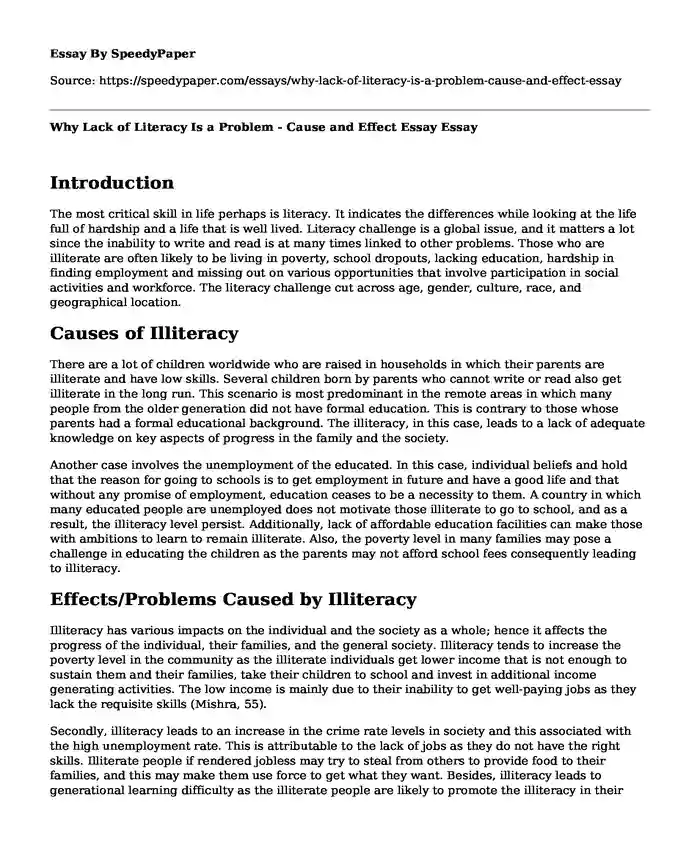
Why lack of literacy is a problem (cause and effect essay; shows separate sections for causes and effects).
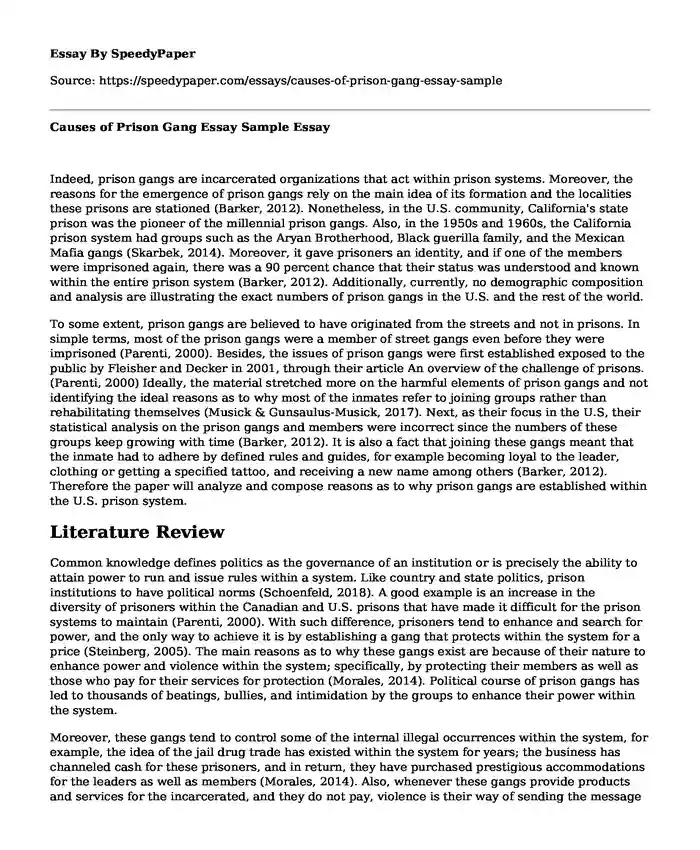
Causes of prison gang (research paper with a literature review; shows how multiple proposed causes can be grouped and supported, rather than a short essay format to copy).
If one of these cause and effect essay examples matches your assignment, use it to study how the writer organizes causes, explains effects, and supports connections with evidence. Then develop your own thesis, research, and analysis rather than rewriting the sample's arguments or wording. Besides, our essay writing service can craft a similar but unique piece for you. Just share the link to the sample you like in the order form, and you’ll get an original version for submission asap.
The student papers below explore causes, consequences, and connections between events. Some follow a cause-and-effect structure, while others demonstrate related approaches to explaining reasons or outcomes. Use the notes beside each link to identify what you can learn from the paper, and check its claims and sources before using it in your own work.
- The short and long-term effects of divorce on spouses and children (discusses reasons for divorce and its consequences for families)
- The common causes of depression among college students (organizes a discussion around contributing factors and their effects on student life)
- What are the benefits of team sports? (groups the effects of sports participation into physical, psychological, and social benefits)
- Cause of climate changes and its effect on our planet (a research-based discussion focusing on the economic consequences of global warming)
- The interconnection between shame and addiction (a reflective case analysis exploring connections between emotional experiences and behavior)
- Why do soldiers fight? (a short explanation of soldiers’ motivations based on a historical account)
- The advantages received due to the reusable rockets (discusses the economic effects of reusable launch technology using events and forecasts from 2015–2016)
Conclusion
Writing a strong cause and effect essay requires more than listing reasons and consequences. Start with a focused topic, investigate the relationships between causes and effects, and develop a thesis that reflects what your evidence can support. Organize your body paragraphs logically and explain how each cause contributes to an outcome, avoiding unsupported assumptions about causation.
Before submitting your essay, review the clarity of your argument, check your citations, and make sure your conclusion reinforces the relationships established in the body. You can also explore our cause and effect essay examples to see how other students organize their ideas and develop evidence-based explanations. Besides, you can also check out our blog for more helpful guides on how to write a descriptive essay and other assignments.
Sources
- 1
Cause-and-Effect Essay. (n.d.). Washtenaw Community College, Writing Center.
https://www.wccnet.edu/learn/departments/engd/writing-center/_documents/essay-structures/cause-and-effect-essay.pdf - 2
Cause and Effect. (n.d.). Kellogg Community College, Writing for Success.
https://www.kellogg.edu/upload/eng151/chapter/writing-for-success-cause-and-effect/index.html - 3
Rhetorical Modes of Writing. (2023). Texas A&M University, Informed Arguments.
https://odp.library.tamu.edu/informedarguments/chapter/rhetorical-modes-of-writing/ - 4
Causes & Effects. (2023). Writing Commons.
https://writingcommons.org/section/discourse/causes-a-effects/ - 5
Sleep Deprivation and Deficiency – How Sleep Affects Your Health. (n.d.). National Heart, Lung, and Blood Institute, National Institutes of Health.
https://www.nhlbi.nih.gov/health/sleep-deprivation/health-effects
Related articles