Began vs. Begun: What's the difference and when to use each?


Began is the simple past tense of begin, while begun is its past participle, typically used with auxiliary verbs such as have, has, or had. For example, “The class began at 9 a.m.” is correct, as is “The class has begun.” However, “The class has began” is incorrect. Your essay grade may depend on whether you choose “has begun” or “has began.” One mistake won’t ruin your chances of rocking the class, but repeated errors might tick off your professor. If you struggle with the verb begin, its past forms, and correct usage, this guide is what you need. We’ll go over the differences, examples, and memorization techniques used by professional academic writers and successful students.
Began vs. Begun. Key differences
The main difference between «began» and «begun» is their grammatical function. Both are forms of the irregular verb «begin», but «began» is the simple past tense, while «begun» is the past participle used in perfect tenses and passive constructions.
| Began | Begun | |
|---|---|---|
| Verb form | Simple past | Past participle |
| Usage | Actions that started in the past | Perfect tenses and passive constructions |
| Auxiliary verb | Not required in affirmative simple past | Required in perfect tenses and passive constructions |
| Example | She began writing. | She has begun writing. |
When to use «began»
«Begin» is an irregular verb. Its simple past form, «began», indicates that an action started in the past, whether or not it has been completed:
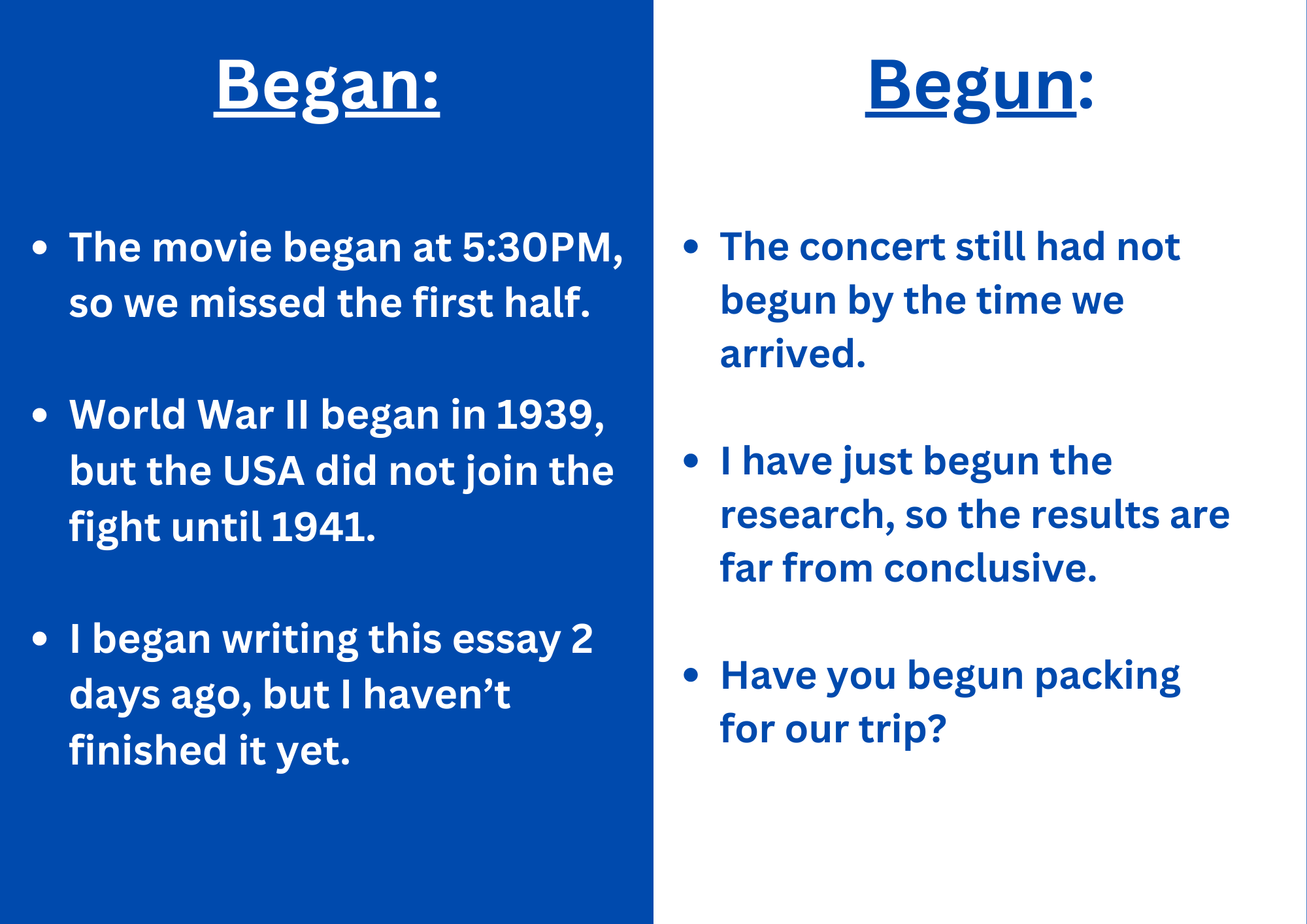
- The movie began at 5:30 PM, so we missed the first half.
- World War II began in 1939, but the USA did not join the fight until 1941.
- I began writing this essay 2 days ago, but I haven’t finished it yet.
Use «began» without an auxiliary verb to form the simple past tense in affirmative sentences.
When to use «begun»
«Begun» is the past participle of the irregular verb «begin». Unlike «began», it is used with auxiliary verbs to form perfect tenses and passive constructions. In perfect tenses, it follows «have», «has», or «had», including combinations such as «will have» in the future perfect. In passive constructions, it is used with a form of «be»:
- The concert still had not begun by the time we arrived.
- I have just begun the research, so the results are far from conclusive.
- Have you begun packing for our trip?
- The investigation was begun last year.
Common mistakes with began and begun
A common mistake is using «began» instead of «begun» after an auxiliary verb or using «begun» as the simple past tense. Remember that «began» is the simple past form, while «begun» is the past participle.
Here are some common mistakes and their corrections:
-
Incorrect: She has began her essay.
Correct: She has begun her essay.
-
Incorrect: The meeting begun at 10 a.m.
Correct: The meeting began at 10 a.m.
-
Incorrect: They had began working before noon.
Correct: They had begun working before noon.
-
Incorrect: The project was began last week.
Correct: The project was begun last week.
You may also encounter «begun» without an auxiliary verb in expressions such as «Well begun is half done». This proverb means that a good start makes the rest of the work easier. Here, «well begun» is a shortened participial construction, not an exception to the grammatical rules.
How to remember when to use began and begun
The theory is well and good, however in practice, many still forget the difference between began and begun. There are 3 ways to remember. Choose the one that suits you best:
- Begun rhymes with «one», reminding you that in perfect tenses, it needs an auxiliary verb such as have, has, or had.
- «U» comes after «A», so if you recall the irregular verbs tables from school, the past participle comes after the past tense conjugation. Therefore, the trio goes: begin — began — begun.
- Some irregular verbs follow a similar vowel pattern in their three forms: begin – began – begun, ring – rang – rung, and swim – swam – swum.
But if you'd rather focus on the bigger picture than grammar details, the write my essay for me service may seem like a tempting solution.
Alternatives and synonyms for began and begun

If you are still in doubt about the right form, you can use another word instead. The suitable synonyms list includes «start» and «commence». The former is a common verb used to describe the onset of something. The latter is a more formal choice suitable for formal letters, research papers, essays. Both of the alternatives are regular verbs, and their past tense forms are created by adding an «-ed» ending:
- Start — started — has started
- Commence — commenced — has commenced
Depending on the context, you can use other alternatives, like:
- Launch (a project);
- Embark (on a quest);
- Set up (a routine);
- Dive into (a discussion);
- Get to (work).
Avoiding word choice and grammar mistakes is a staple of high-quality writing and professionalism. If you ever forget the rules or get confused again, revisit this article or seek professional help with a simple “edit my essay” request before submitting your paper.
Sources
- 1
Irregular Verbs. (n.d.). British Council LearnEnglish.
https://learnenglish.britishcouncil.org/free-resources/grammar/english-grammar-reference/irregular-verbs - 2
Verbs and Verb Phrases: Typical Errors. (n.d.). Cambridge Dictionary, Cambridge University Press.
https://dictionary.cambridge.org/us/grammar/british-grammar/verbs-and-verb-phrases - 3
Begin. (n.d.). Cambridge Dictionary, Cambridge University Press.
https://dictionary.cambridge.org/us/dictionary/english/begin
Related articles