How to analyze art as a primary source in a history essay

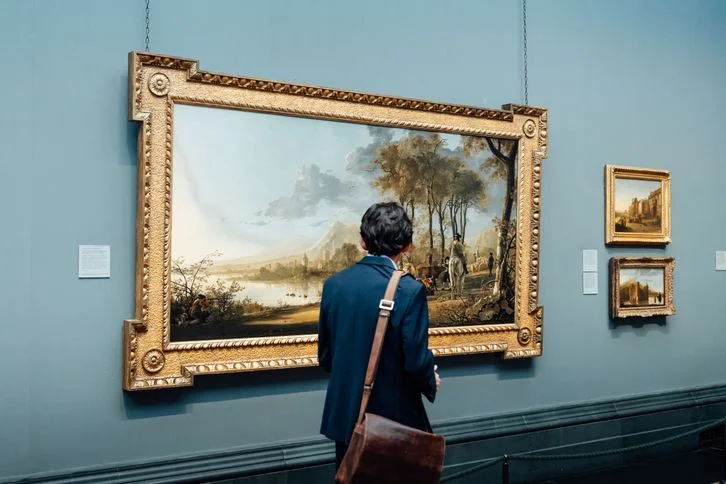
A painting, photograph, poster, sculpture, film, or installation can provide historical evidence just as a letter, newspaper, speech, or government record can. The difference is that visual sources rarely tell you directly what they mean. You have to examine how they were created, what they represent, whose perspective they preserve, and how they relate to other evidence.
That makes analyzing art in a history essay different from simply describing an artwork. Saying that a painting contains ruined buildings, dark colors, and several isolated figures is observation. Explaining how those choices reflect a particular response to war, displacement, or urban destruction – and supporting that interpretation with historical evidence – is analysis.
This guide explains how to make that transition from looking at an artwork to using it as credible evidence in a historical argument.
For larger academic projects where the challenge extends beyond one source analysis to research design, organization, or sustained argumentation, SpeedyPaper also provides a buy dissertation option for students seeking broader writing assistance. Any outside assistance should, of course, be used according to your institution's academic-integrity requirements.
Can art be a primary source?
Yes, but whether an artwork qualifies as a primary source depends on the research question.
A primary source is evidence created during the period being studied or evidence that gives direct access to the perspectives, activities, or cultural production relevant to your historical question.
For example, suppose your paper asks:
How did American artists represent industrialization in the late nineteenth century?
A painting created in 1890 may be a primary source because it is part of the visual culture produced during the period you are examining.
But imagine a different question:
How have twenty-first-century artists remembered the Lebanese Civil War?
In that case, an artwork made decades after the conflict may still be a primary source – not for reconstructing exactly what happened during the war, but for studying later memory, commemoration, identity, or interpretation.
The status of the source therefore depends on what you are trying to prove.
A recent artwork about an ancient event is not primary evidence for the ancient event itself. It may, however, be primary evidence for how modern society interprets that event.
Art as evidence vs. art as illustration
One of the most common mistakes in history essays is using an image merely to decorate a point already established through written sources.
That is illustration, not source analysis.
Suppose your paper states:
Urban areas experienced destruction during the conflict.
You then insert a photograph of a damaged street. Unless you analyze the photograph, it functions mainly as an illustration.
A stronger approach would ask:
- Who took the photograph?
- When was it taken?
- What part of the city does it show?
- Was it documentary journalism, personal photography, propaganda, or later artistic work?
- What has the photographer included or excluded?
- Where was the image originally published or exhibited?
- What historical claim can the image support?
- What can it not establish on its own?
Now the image becomes evidence.
Start with provenance
Before interpreting symbolism or meaning, establish where the artwork comes from.
In historical research, provenance refers to the origin and history of an object or source. For an artwork, basic provenance questions include:
- Who created it?
- When was it created?
- Where was it created?
- What medium was used?
- Who commissioned or financed it, if anyone?
- Where was it originally displayed?
- Who was expected to see it?
- Has its title, ownership, location, or interpretation changed?
- Is the version you are examining the original or a reproduction?
These facts can substantially alter your interpretation.
Consider a political mural. The same imagery means something different if it was produced spontaneously by protesters, commissioned by a government agency, created years later for a museum exhibition, or recreated from an earlier photograph.
Do not begin by assuming that the image transparently represents historical reality. First determine what kind of object you are actually looking at.
Separate observation from interpretation
A disciplined visual analysis usually develops in two stages.
Record what you can actually see
Describe observable features without immediately assigning meaning.
Look at:
- figures;
- clothing;
- facial expressions;
- gestures;
- buildings;
- landscapes;
- objects;
- written text;
- symbols;
- perspective;
- scale;
- composition;
- color;
- light and shadow;
- empty space;
- repetition;
- placement of figures;
- signs of movement;
- medium and material.
For film or video, also consider:
- editing;
- camera position;
- sequence;
- sound;
- narration;
- duration.
For an installation, pay attention to the viewer's physical relationship with the work.
Suppose a photograph shows a person standing in front of a partially destroyed building.
An observation would be:
The central figure occupies a small part of the frame, while the damaged building dominates the background.
Interpret what those details may mean
An interpretation might be:
By making the individual visually small in relation to the damaged architecture, the photograph emphasizes the scale of destruction and the vulnerability of civilians within the urban landscape.
The second statement makes an argument. It must therefore be supported and tested rather than treated as an obvious fact.
Establish historical context
Once you understand the object itself, place it within the circumstances that produced it.
Ask what was happening politically, socially, economically, and culturally when the work was created.
Relevant context might include:
- war or political instability;
- migration;
- economic change;
- colonialism or decolonization;
- social movements;
- religious debates;
- technological change;
- urban development;
- censorship;
- changing gender roles;
- artistic movements;
- government patronage;
- museum and gallery culture.
Context prevents you from interpreting visual details in isolation.
Imagine that a painting contains an abandoned railway station. Without contextual research, you might interpret it simply as a symbol of loneliness. But if the railway had recently closed because of economic restructuring, the image could also relate to unemployment, regional decline, or changing transportation systems.
Strong historical analysis moves constantly between what is visible and what was happening historically.
Ask who produced the image and why
Authorship matters because historical evidence always comes from a position.
Research the artist or creator when that information is available.
Consider:
- their social background;
- political circumstances;
- relationship to the event represented;
- artistic training;
- intended audience;
- institutional affiliations;
- whether they experienced the event directly;
- whether they created the work contemporaneously or retrospectively.
Avoid reducing the artwork to biography, however. An artist's nationality, political beliefs, or personal history can provide useful context, but these facts do not automatically determine the meaning of every artistic choice.
Purpose also matters.
An image created for a government propaganda campaign should be evaluated differently from a private sketch, documentary photograph, memorial sculpture, museum installation, or commercial advertisement.
The question is not simply, "Is this source biased?"
Almost every historical source reflects a perspective.
A better question is:
What perspective does the source preserve, and how does that perspective affect what historians can learn from it?
Examine the intended audience
Primary sources communicate within social situations.
Ask who was expected to encounter the artwork.
A public monument addresses an audience differently from a private portrait. A political poster is designed to persuade. An experimental gallery installation may assume viewers already know something about the event or debate it references.
Audience can influence:
- subject matter;
- symbolism;
- language;
- scale;
- location;
- level of ambiguity;
- political message.
You should also distinguish the original audience from later audiences.
A photograph originally published in a newspaper may acquire a very different meaning when displayed in a museum 40 years later. Historical analysis can consider both contexts, but they should not be conflated.
Compare the artwork with other sources
An artwork rarely provides enough evidence to support a major historical conclusion by itself.
Corroboration strengthens your interpretation.
Compare visual material with evidence such as:
- newspapers;
- diaries;
- letters;
- government documents;
- speeches;
- census data;
- maps;
- oral histories;
- photographs;
- archival records;
- contemporary criticism;
- scholarly books and journal articles.
Suppose an artist depicts a public square as empty during a period of political unrest. Other sources might show that the square was normally crowded but became deserted after a curfew.
That contextual evidence makes the artistic representation historically meaningful.
Alternatively, contemporary photographs may show large demonstrations in the same square. The discrepancy does not automatically make the artwork unreliable. It may indicate that the artist is emphasizing fear, absence, memory, or another dimension of the event.
Contradiction can itself become evidence.
Use secondary scholarship to test your reading
You should distinguish between your primary visual source and scholarship written about the artwork, artist, movement, or historical context.
A museum catalog essay, academic journal article, or historian's interpretation is usually a secondary source for your purposes.
Secondary scholarship can help you:
- understand historical background;
- identify established interpretations;
- learn relevant terminology;
- discover related primary sources;
- recognize debates among scholars;
- avoid interpretations contradicted by basic factual evidence.
But do not simply replace your analysis with someone else's.
If a scholar argues that a painting represents collective memory, explain why the visual evidence supports or complicates that interpretation.
Your essay should demonstrate your reasoning.
A useful case: Lebanese art, memory, and historical narrative
Lebanese contemporary art offers a particularly useful example because many artists have engaged with questions of conflict, memory, public space, archives, and historical narrative.
The art organization represented at apeal-lb.org historically promoted Lebanese art through exhibitions, commissions, cultural initiatives, and education. Its exhibition Subtitled: With Narratives from Lebanon brought together paintings, sculptures, mixed-media installations, photography, and film, illustrating how historical experience can be approached through different visual media.
A related discussion on apeal-lb.org about art as historical evidence is useful precisely because it approaches the issue from the art and cultural-memory side rather than from academic essay technique. For a history student, the next step is methodological: determining how such material can be evaluated as evidence rather than simply cited as an example of Lebanese culture.
Consider a work about a past conflict.
You might ask:
- Was the artist a witness to the event or part of a later generation?
- Does the work use archival photographs or found documents?
- Does it reconstruct memory rather than document the original event?
- Is the work addressing individual memory or collective memory?
- Does the exhibition setting influence its interpretation?
- What other evidence supports or contradicts the narrative presented?
Those questions transform an art object into a historical source that can participate in an argument.
How to turn visual evidence into a thesis
Source analysis should eventually lead to a historical claim.
A weak thesis simply identifies the subject:
Lebanese artists have created works about war and memory.
That is largely descriptive.
A stronger thesis establishes a relationship that can be defended:
By reworking photographs, personal memories, and damaged urban landscapes, postwar Lebanese artists have challenged the idea of a single authoritative record of conflict, presenting historical memory as fragmented and continually reconstructed.
This thesis gives the essay analytical direction.
You can now organize evidence around several concepts:
- archival material;
- personal testimony;
- urban space;
- competing memories;
- artistic reinterpretation.
Each artwork has a function within the argument instead of appearing as an isolated example.
Building a body paragraph around an artwork
A strong paragraph usually does more than introduce and describe the source.
A useful structure is:
-
Claim
State the historical point the paragraph will establish.
-
Evidence
Introduce the artwork and identify the relevant visual feature.
-
Context
Explain the historical circumstances necessary to interpret it.
-
Analysis
Show how the specific feature supports your claim.
-
Corroboration or complication
Connect the artwork with another primary source or scholarly interpretation.
-
Link to thesis
Explain why the evidence matters to your overall argument.
For example:
Postwar representations of urban space can reveal how physical destruction becomes part of collective memory. In the artwork, damaged architecture occupies most of the composition while human figures appear at the margins. Rather than functioning merely as background, the buildings become the visual focus of the scene. Read alongside accounts of reconstruction and displacement, this emphasis suggests that the built environment operates as a repository of memory. The work therefore provides evidence not simply of destruction but of how destruction was subsequently remembered and interpreted.
Notice how little of the paragraph is pure description.
Most of it explains why the visual evidence matters.
Common mistakes when analyzing art as historical evidence
Treating symbolism as fact
If a figure is painted in red, you cannot automatically state that red "represents violence."
Use cautious analytical language:
- suggests;
- emphasizes;
- evokes;
- may indicate;
- can be read as.
Then support the interpretation.
Ignoring when the artwork was created
A painting made in 2005 about an event in 1975 tells you directly about how the past was remembered in 2005 – not necessarily how people understood it in 1975.
That distinction can be central to the paper.
Assuming photographs are objective
Photographs involve framing, timing, selection, captioning, publication, and sometimes editing.
Treat them as constructed historical sources rather than transparent windows onto reality.
Overgeneralizing from one artist
One person's artwork cannot automatically establish what "Lebanese people," "women," "workers," "Americans," or another broad group believed.
Specify whose perspective the work represents.
Describing instead of arguing
Long descriptions of colors, objects, and figures are useful only when those observations contribute to your historical claim.
After each significant observation, ask:
So what does this show about my historical question?
Citing artwork correctly
Citation practices vary by style guide and assignment.
Your citation may need information such as:
- artist;
- title;
- date;
- medium;
- collection or museum;
- location;
- website or database;
- access information.
Chicago style is common in history courses, while MLA and APA may appear in interdisciplinary assignments.
Follow your instructor's required style rather than inventing a format.
Also distinguish between citing the artwork itself and citing a webpage where you viewed a reproduction. They are related but not necessarily identical sources.
A final source-analysis checklist
Before using an artwork in your essay, make sure you can answer these questions:
- What exactly is the source?
- Who created it?
- When and where was it produced?
- Why is it primary evidence for my specific research question?
- What do I directly observe?
- What am I interpreting?
- What historical context affects that interpretation?
- Who was the intended audience?
- What perspective or limitations does the source have?
- What other evidence corroborates or challenges it?
- How does it support my thesis?
If you cannot explain the last question, the artwork probably has not yet become useful evidence in your paper.
From visual source to historical argument
The most important principle is simple: do not ask an artwork to prove more than it can.
Visual sources are especially powerful for studying representation, political imagery, cultural values, memory, identity, public space, everyday life, and changing interpretations of historical events. Their subjectivity is not necessarily a defect. In many research questions, that subjectivity is precisely what makes them historically valuable.
Your job is to identify the perspective, establish the context, examine the visual details, compare the work with other evidence, and explain what the source contributes to a historical argument.
An artwork should therefore never appear in a history essay simply because it relates to the topic. Once you establish provenance, distinguish observation from interpretation, corroborate the visual evidence, and connect it directly to your thesis, art can become one of the most revealing primary sources available to a historian.
Related articles